Imposter Monster
A party game I built with Claude because every app had ads and zero Malayalam words
Arun Sajeev
6 min read · Mar 14, 2026
Game nights are sacred
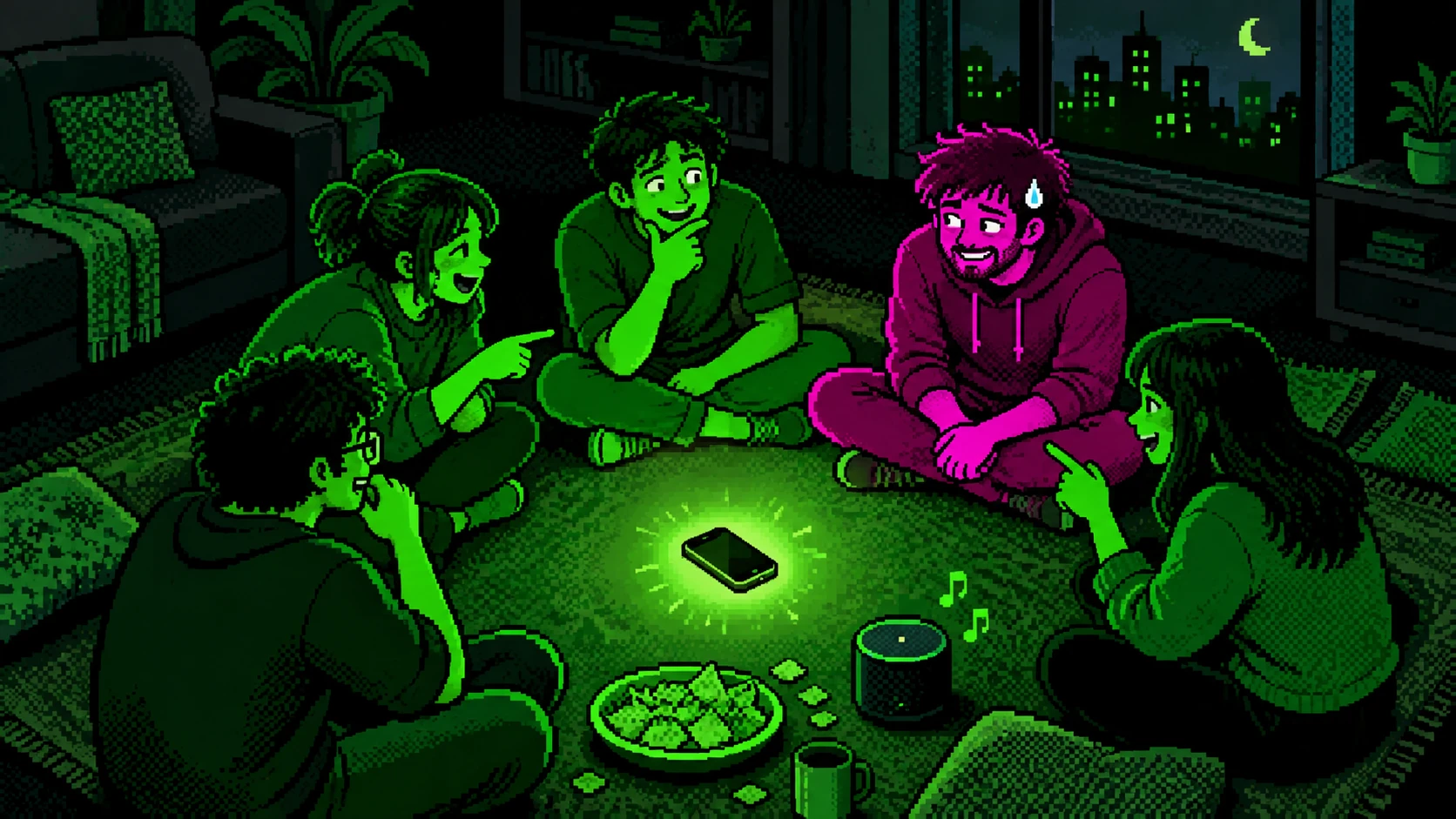
Game nights with friends are sacred in our group. We cook food, someone puts on music, and at some point someone pulls out their phone and says "let's play the imposter game."
If you haven't played it before, everyone gets the same secret word on a phone except one person (the imposter). You go around giving clues, and everyone tries to figure out who's faking it. The imposter tries to blend in without knowing the word. It's chaotic, hilarious, and has caused at least three friendship-ending arguments.
The game itself? Perfect. The apps we used to play it? Terrible.
The problem with every app we tried
Picture this. You're in the middle of an intense round. Everyone's given their clue. The room is tense. You're about to vote. And then, a full-screen video ad for some random mobile game. 30 seconds. Unskippable. By the time it's done, the energy is gone.
That was problem number one. Ads everywhere. Between every single round.
Problem two was the words. Every app had the same generic English word lists. "Thanksgiving." "Baseball." "Prom." We're a group of friends in Kerala. None of these words mean anything to us.
The best rounds of this game happen when the word triggers a shared memory. When someone gives a clue that's just obvious enough that half the room groans and the other half gets suspicious. That only works when the words are part of your world.
Where's "Drishyam"? Where's "Puttu"? Where's "Tenga kola"?
Problem three: unnecessary complexity. Room codes, multiple devices, Wi-Fi dependency, sign-ups. We just wanted to pass one phone around a circle. That's the whole requirement.
We didn't need a better imposter game app. We needed our imposter game app.
"I'll just build it"
I've been building weekend side projects with Claude for a while now. Small tools, fun experiments, things that scratch a personal itch. So when this frustration came up for the tenth time at a game night, the thought was obvious.
The requirements were simple:
- One phone, passed around. No multi-device setup, no Wi-Fi after first load.
- Zero ads. Zero sign-ups. Zero friction. Open a link and play.
- Malayalam pop culture categories. Movies, food, actors, songs, slang.
- A clean dark UI that works in a dimly lit living room.
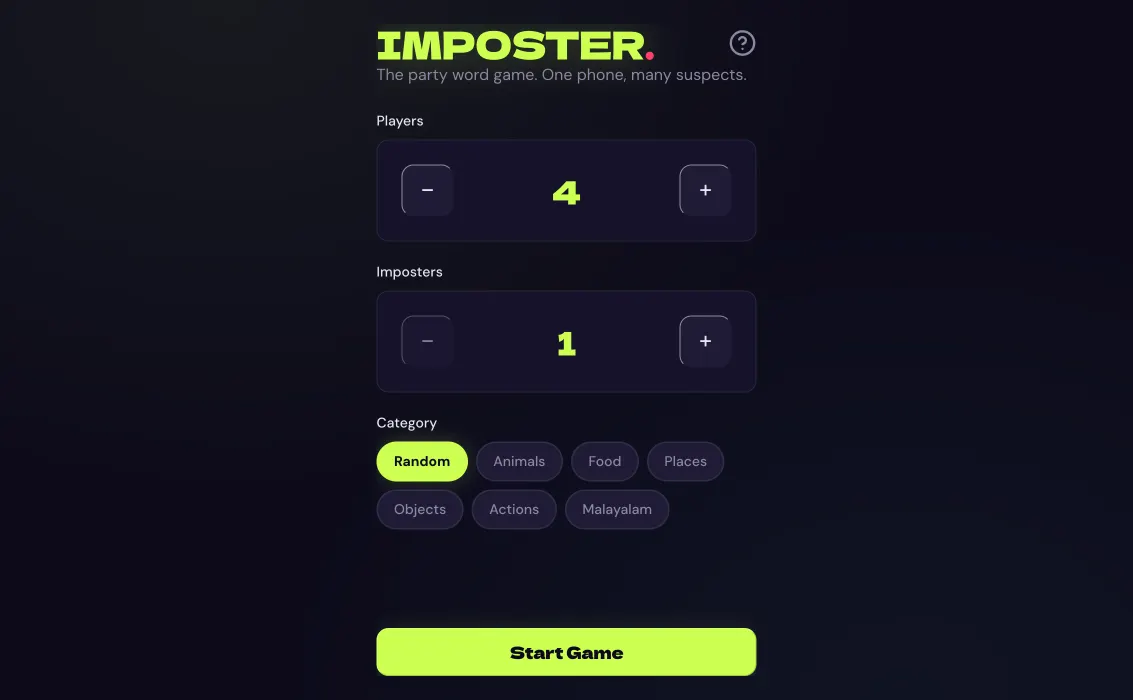
- Configurable player count and imposter count.
The name came naturally. I run my personal brand and side projects under "Inspired Monster," so "Imposter Monster" felt like it belonged. Playful, a little ridiculous. Perfect for a party game.
How I built it with Claude
I didn't code this in the traditional sense. I built the whole thing through conversations with Claude, Anthropic's AI assistant. Here's what that actually looked like.
Game logic
I described the mechanics in plain language. Here's the game, here's the pass-the-phone flow, here's what happens at each stage. Claude got the core working fast. Random imposter selection, word assignment, the turn-by-turn reveal.
The tricky part was the pass-the-phone mechanic. Each player taps to reveal their role privately, confirms they've seen it ("Got it, pass the phone"), and hands it to the next person. No peeking, no spoilers. Claude nailed this flow on the first pass.
The word lists
This was the heart of the project. And the most fun part.
I worked with Claude to build categories rooted in Malayalam and Kerala pop culture. Movies. Food. Actors. Directors. Songs. Slang. I curated and refined them with my own picks.
Words like "Mammootty," "Karikku," "Porotta," "Premam." Words that make our group erupt. Words where the imposter panics because they can't tell if the clue refers to the movie or the actor or the dish.

This is the part that no existing app could ever get right for us. The cultural specificity is what makes the game come alive.
UI and experience
As a designer, the UI wasn't an afterthought. I directed Claude through the visual decisions. Dark theme because game nights are evening events. Bold typography. Big tap targets because someone's going to use this with one hand while holding a plate of food with the other.
The states had to be crystal clear. "Tap to reveal your role." "Got it, pass the phone." "Time to discuss!" Even someone who's never played should follow along without anyone explaining it.

Ship it
Settings screen for player and imposter count. Category selector. Share button so I can text the link in our group chat. Deployed to Vercel. Done.
What building with AI actually looks like
There's a lot of hype around "building with AI" so let me just tell you what it actually looked like. It's not "make me a game" and out comes a finished product.
My workflow: describe what I want in natural language. Be specific about the feeling, not just the features. Claude generates code. I test it. I find what doesn't feel right. I describe the issue. Claude iterates. Repeat.
The critical ingredient was taste. Claude is fast at writing functional code. But knowing that the tap target needs to be bigger because someone's using it while eating biryani? Knowing that "CID Moosa" is a funnier word than "Lucifer" for the movies category? Knowing that the reveal animation needs to feel satisfying and not just functional? That's the human part.
AI didn't replace my design skills. It amplified them. I could move at the speed of my ideas instead of being bottlenecked by implementation.
Claude handled the execution speed. I brought the vision, the cultural context, and the design sensibility. It's a collaboration, not a replacement.
Design decisions that mattered
- Web app, not native. A URL is the fastest distribution channel. "Open this link" beats "download this app" every time, especially mid-hangout.
- Dark theme. Evening activity. Easier on the eyes. Looks better when the lights are dim.
- Zero ads. This is a passion project for my friends. Ads are the exact thing we were running from.
- Configurable imposters. With 4 people, 1 imposter works. With 8+, 2 imposters makes it way more chaotic. We learned this the hard way.
How it turned out
Imposter Monster is now the default at our game nights.
No more ad interruptions. No more explaining why "Thanksgiving" is a word when nobody at the table has celebrated it.
Setup takes 10 seconds. Open the link, pick players, choose a category, start. The rounds are faster because there's zero friction between them.
What I took away
Build for your own frustration. The best side projects solve a problem you personally feel. I didn't need user research. I just needed to remember the last time an ad ruined a perfectly good round.
Cultural context is a superpower. Global apps optimize for the widest audience, which means they lose the specificity that makes things personal. A game about "Mammootty vs Mohanlal" debates hits differently than generic movie categories.
AI as a collaborator, not a shortcut. Claude didn't design this game. I did. Claude made it possible to go from idea to shipped product in a weekend instead of weeks.
Ship it, then play it. The first version wasn't perfect. But it was playable by Saturday evening, and by Sunday I had real feedback from an actual game night. That loop is worth more than weeks of polishing alone.
Sometimes the best product is the one you build for yourself and five friends on a Saturday night.